My Haunted Library

All things spooky. Your source for paranormal and supernatural book and movie reviews, strangeography, Halloween crafts and a little cozy fall baking.


Leave a comment

Review: First Grave on the Right

First Grave on the Right  Darynda Jones, 2011.

Charley Davidson lives up to her tough, sound-alike name.  She’s an ADD, smart-ass private investigator with a tender heart.  And the ability to see dead people.  And help them cross over.  Yep.  She’s a good-looking grim reaper minus the cowl and scythe.  Dead people flock to her shininess and pass through her to the other side.

Charley has helped skyrocket her Uncle Bob’s police career with her inside intel from dead folks, but the rest of the force is a little skeptical – or creeped out – by her abilities. But Charley doesn’t mind: she’s used to keeping a barrier up between herself and…normal people.

When three attorneys are killed in the same night, they come to Charley to help solve their murders and draw Charley into a human trafficking investigation.  If that isn’t enough, a seriously hot entity has been steaming up her dreams – and soon moves into her reality.  This sexy visitor seems to be someone – or something – from Charley’s past.

First Grave on the Right is a fun read.  While the murder-mystery is not super-mysterious, and Charley’s savvy quips can wear a little thin, Jones’ characterization carries the story with good humor, enjoyable supporting characters, and some exciting action.  (Both kinds: police and romantic.)

A funny, spicy, light mystery with an interesting take on the paranormal PI motif.


1 Comment

Review: The Haunted House Diaries

The Haunted House Diaries: The True Story of a Quiet Connecticut Town in the Center of a Paranormal Mystery. William J. Hall, 2015.

The first 173 pages of this book are absolutely riveting.  We are treated to perhaps the most well-documented, pervasive haunting across time of a 1793 New England home: The Fillie home in Litchfield, CT.

Starting in 1966 when she was sixteen years old, Donna Fillie recorded her observations of strange and paranormal events in her home on any scrap of paper she could find: from the backs of envelopes, to her kids’ school papers.  She continued her documentation all the way through the winter of 2015.

Fillie’s verbatim notes are straightforward, honest and intelligent.  She and her family take experiences in stride that would send others scrambling for a new home.

For instance, the Fillies have witnessed strange, elongated figures; jewelry gone missing and returned in different places; orbs; toys moving on their own; clocks that shouldn’t work ticking away; weirdly shaped creatures; voices laughing, groaning, and even talking; footsteps following family members throughout the house; even UFOs.  Fillie emphasizes that the family is not afraid, but desperately looking for answers.

Fillie’s integrity shines through her writing, as does her frustration with all the bizarre events taking place around her family.  She simply wants to know.  What does it all mean?  If spirits or entities can do all these things – from levitating glassware to raining money – why can’t they communicate more clearly?

It is the latter part of the book that is a letdown.  It struggles with organization and almost undermines Fillie’s heartfelt and carefully documented account.

Author William J. Hall, a performing magician and paranormal investigator, begins by cautioning us to be aware of our preconceived beliefs regarding paranormal.  How we interpret things is dependent on our life context and our own belief systems.  Yet Hall himself offers some potentially controversial beliefs from his own perspective as givens for us.  The existence of a multiverse. Possessions, and extending that, evil, are in the eye of the human-centered beholder and “can always dispelled without the use of any religion.”

We are then offered opinions on select elements of the hauntings in Fillie’s diary by two experts in the field, Paul Eno and Shane Sirios.  If you have not heard of them before reading this book, you are not given much of a background introduction to their work here.  Eno is known for his radio show, Behind the Paranormal, and Sirois is the founder of trueghost.com.  According to Hall, Sirios’ near-death experience has made him sensitive to otherworldly things and he has a 100% success rate “resolving” paranormal problems and parasites for people without using religion.

The investigation section covers a scant sixteen pages and is mostly impressions of things that Sirios senses in and around the home, such as someone running outside, a sensation of non-human entities, the perception of a protecting entity Native American spirit in backyard, and the feeling that the land is a portal to the multiverse.

It seems this investigation has taken place across multiple visits to the home, but the reader doesn’t get a good sense of its chronology or how it took place.  What methods were followed, what experiments were tried, what evidence was accumulated?  There are a few photographs, and references to EVP recording data that seems to validate the presence of a “Harry” who might have originally helped build the house.  But after reading Fillie’s methodical documentation, the investigation and analysis part of the book seems like a hodgepodge.

What begins as a fascinating account of one family’s dissolves into a mixed bag of opinions and snippets of investigation.  The Haunted House Diaries is definitely worth reading for the first half, and is frustratingly interesting for the second.


Leave a comment

Review: Infinite

Infinite.  Jeremy Robinson.  2017.

Jeremy Robinson is best known for his over-the-top action-adventure and kaiju monster novels.  In Infinite, he branches successfully into science fiction.

Our protagonist, William Chanokh, been in cryosleep – but with his mind awake – for the last ten years of a long journey.  He is a tech-jock, and along with fellow scientists and engineers, he is part of humanity’s last hope of survival.  Will and his teammates are on a mission to colonize Kepler 452b, the nearest – relatively – habitable planet to earth.

Unfortunately, there is a snafu: Will is pulled from his cryochamber, murdered by Tom, one of his fellow tech-jocks, and dies.  And then comes back to life.  And discovers that Tom has assassinated all the remaining crew but one: Will’s secret crush, Capria.

Things deteriorate further when Will realizes that Tom has drastically altered the programming of Galahad, their spaceship, in both subtle and not-so-subtle ways.  What follows is an almost boyish romp through outer and inner space.  There is a sexy and dangerous Artificial Intelligence, cool robot battles, planetary adventures with weird creatures, and virtual reality thrills – all at faster-than-light travel through the universe.

Infinite is more introspective than Robinson’s usual straightforward action stories.  He focuses a bit more on character development – which is a welcome plus – and entertains meditations on the nature of existence.  Could we all just be a simulation?   Just a piece of programming?  And what if we are?  Will debates the pointlessness of immortality versus the need to find joy in every day.  Robinson himself faced some personal issues that altered his own life perspective while writing this book, and they certainly come through in Will’s existential questions.

Action prevails, however, and Infinite is a fun, fast read. Toss in a nice dose of humor – including a nod to Star Trek – some light romance, and of course, all that action, and you get a great summer escape.


Leave a comment

Review: The Graveyard Apartment

The Graveyard Apartment – Mariko Koike, 1993.

Translated from the Japanese by Deborah Boliver Boehm, 2016.

Misao can’t believe her good fortune when she and her young family move into Central Plaza Mansion in the spring of 1987.  The new high-rise apartment building sports fourteen spacious luxury units and is only twenty minutes from the center of Tokyo and close to local schools and shopping.  It is surrounded by cherry trees and lush greenery and…a graveyard.  From their balcony, Misao can see the morbid grave markers and the pall from the smokestack of the crematorium at the Buddhist temple.  Aside from a few distant, empty weed-covered buildings, Central Plaza Mansion stands alone next to the sprawling graveyard.

Misao tells herself that life will be wonderful here for her and her daughter Tamao and husband Teppei if she can just get over her unease with the cemetery.  Needless to say, everything will not be wonderful.  The inexplicable death of their pet white finch after they move in heralds trouble to come.

The few tenants in the building start experiencing eerie and inexplicable events: voices whispering in the basement.  Strange images on their televisions.  And, one by one, neighbors start to move out.

After Teppei and the resident  managers are rescued from a basement ordeal, Teppei agrees that their family also needs to get out of Central Plaza Mansion.  He and Misao look desperately for new place to live, but will they be allowed to leave?

The Graveyard Apartment moves along quickly.  The novelty of a foreign locale and customs gives a little extra spice to the story.  The characters are relatable, but their emotions feel explained, rather than evolved from their dialogue and actions.  This may be a factor of the translation (which seems aptly done) or simply a style choice, but does end up feeling a bit stiff.

More frustrating, however, is the use of the supernatural elements.  The scary bits are neat: the imagery is effective and the suspense is strong.  Unfortunately, there is such a wide variety of seemingly unconnected horror devices it proves vexing.

One doesn’t see how the white handprints appearing on outside of the apartment building connect with the Lovecraftian entity in basement, the nuclear-acting beams of light, the shadow figure in television, the seemingly possessed elevator, or the preternatural attack on Tamao or the violent death of Pyoko, the finch.

Is it just the proximity of a graveyard?  Does it have something to do with the abandoned subterranean shopping mall that dead-ends in the basement?  Does the suicide of Teppei’s ex-wife play into the hauntings?  All of these things are hinted but not brought to fruition, leaving the reader impatient.

Because the background story threads are not woven together, the reader also doesn’t know how to interpret the horror elements and it lessens their effect.  Mr. Shoji, an intriguing character with the potential to help out the reader – and the other characters – unfortunately exits early in the story.

All said, The Graveyard Apartment is not a bad read: it does hold interest until the somewhat anticlimactic end.  It just lacks the cohesion that would have made it great.


1 Comment

Review: Dogs of War

Dogs of War.  Jonathan Maberry.  2017.

Technophobes and luddites might just have the right mindset if the premise of Maberry’s rip-roaring new thriller is to be believed: A technological apocalypse is primed to eliminate several billion useless humans, allowing the intellectual elite to live in harmony with advanced artificial intelligences.  Rich, evil geeks and brilliant robots will take over the world.

Fortunately, Captain Joe Ledger is on the job.  Even more cynical.  Ready for action.

But Joe and his team are damaged in spirit.  Suffering from events in their previous adventure, Kill Switch, that turned their worlds upside down, they’ve let uncertainty creep into their psyches.  Their Department of Military Services, backed by their enigmatic boss, Mr. Church, has lost credibility.  Their own skills are under question.

Joe is called in by his brother Sean, a Baltimore cop, to help investigate the unusual death of a runaway teen turned prostitute.  When they discover nanites in her brain programmed to deliver a targeted disease, Joe realizes this is part of a much larger, much more insidious plot that was put in motion decades earlier by a nemesis of the DMS.

Now going by the name John the Revelator, this archenemy is a mysterious preacher of the curated technological singularity.  John has molded the destiny of one Zephyr Bain, a brilliant, rich, ruthless roboticist.  United with John’s vision, Zephyr designed Calpurnia: the first self-aware artificial intelligence and the key to coming apocalypse.

Can Joe and his team regain their mojo?  Can Calpurnia be stopped?  Readers are in for a wild ride before those questions are answered.

This new installment in the Joe Ledger series is a highly rewarding read.  The characters are old friends if you’ve followed them since Patient Zero, but are so well-drawn – and continue to be developed – that there is no problem getting to know them if this is your first adventure with the team.  Ledger himself is a complicated tough guy with a heart of gold.  He’ll tell you he has three personality types vying for dominance: Modern Man, Cop, and Killer.  Even the bad guys have life-like vulnerabilities and memorable personalities.

The plot is intriguing and disturbingly possible.  The combination of an immediate and engaging style – we fly between Joe’s first-person narration to tense third person – dynamite action sequences, and just a whisper of the supernatural, makes the book tear along.  Nearly every chapter ends with a cliffhanger.  Dogs of War is hands down a great read.  Nice job again, Mr. Maberry.


Leave a comment

Review: Ararat

Ararat. Christopher Golden. 2017.

Golden’s new genre-bending novel combines elements of adventure, thriller, and horror with mixed success.

Fiancés Adam and Meryam are known world-wide for their sensational adventure documentaries. When their friend and mountain guide, Feyiz, alerts them to a potential archaeological scoop the two race to Turkey to be first on site at a remarkable discovery.

In a cave exposed by a recent avalanche high on Mount Ararat, the adventurers find the remains of a giant wooden ship filled with animal stalls and both human and animal remains: what can only be the lost ark of Noah.  But there is something else amidst the ancient debris.  In a coffin-like box sealed with bitumen they uncover a humanoid corpse sporting curved horns.  A mutated human? Or… a demon?

Ben Walker, an undercover DARPA agent is helicoptered in along with UN observer Kim Seong, and Father Cornelius Hughes, an expert on ancient civilizations.  Walker’s job is to see if the unknown creature poses any threat, and if so, how the US can utilize it.

Their arrival on the site adds to the already growing tensions among the assembled team of archaeologists, mountain guides and Turkish government monitors.  Is it the remote location and close quarters bringing out the worst in people?  Or could the creature in the box be exerting some strange influence?  As project members start to disappear and unexplained violence ramps up, Walker has his hands full trying to find these answers.

Ararat is a solid read.  The premise is great.  All the right elements are here: an isolated and treacherous location, a rising storm, a collection of disparate characters holding secrets, a supernatural element…yet it could have been so much deeper.  The story feels formulaic and the reader is left wishing it had been more fleshed out all the way around: the history, the ancient languages, the potential religious conflicts and ramifications.  The characters have backstories, but not enough for one to care much about them.  There is not enough mountain climbing to make it a great action climbing story, and not quite the level of deep, creeping fear for a stunning horror novel.  Suspense builds unevenly, and even the demon ends up a bit of a disappointment, as it focuses more on wanton destruction than insidiousness.

Ararat succeeds as a quick-read adventure thriller, but had the potential to be much more.


1 Comment

Aliens or Infants: Supremely Effective & Creepy Props

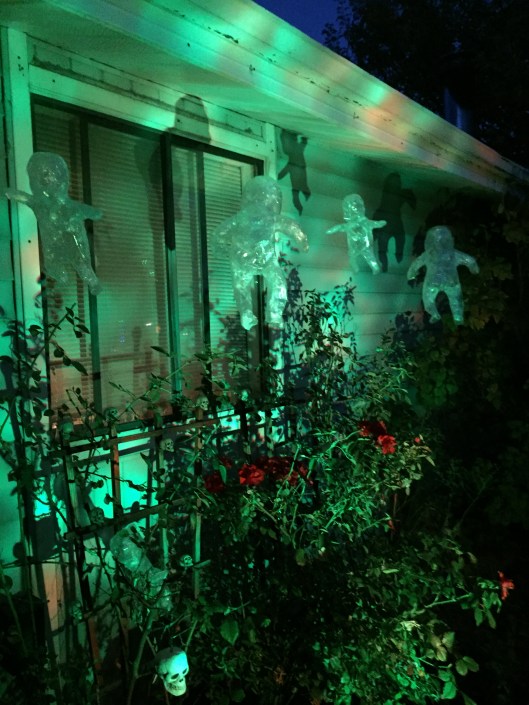
On a crisp fall bike ride through a nearby neighborhood just before Halloween, I stopped in my tracks, staring the most unique decorations I had ever seen.  Floating eerily in front of a house were life-sized, translucent, faceless human figures with full tattered skirts. I was mesmerized.

I biked home as fast as I could and did a little research: tape sculptures. I had no idea there was such a thing.  I found the Storker Project online and was instantly inspired to make tape babies.
tapebabiesgreen5

The results were as creepy as I’d hoped. My husband was a little nervous about hanging disturbing, full-sized, featureless infants over our rosebushes, especially after I added a slowly pulsating green and orange strobe light. Amazing!

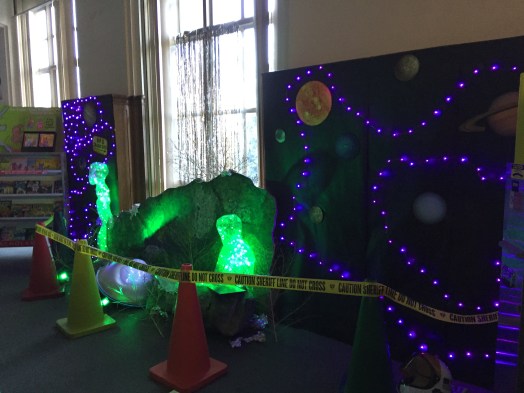
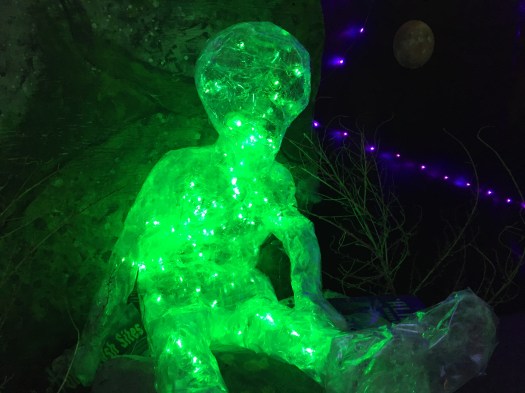
So when it was time for this year’s spring book fair, what could be better than recreating the Roswell crash with life-sized tape aliens? Answer: nothing!

2017-05-12 07.15.20

The process is time-consuming, but remarkably easy. Try it, you’ll be astounded by the results.
2017-05-12 07.15.01

You need:

  • Good-quality clear packing tape – I used Duck Tape
  • Kitchen plastic wrap
  • Craft knife
  • For babies:
    • Use a doll. Try Walmart or your local thrift store. Or if you have children, appropriate a doll. With their permission.
  • For aliens:
    • Pick a person.  Ideally someone who doesn’t have long hair.  Hair and Duck Tape are a bad combination.
    • A Styrofoam head. Check a beauty supply shop. I found them at Sally Beauty Supply for $5.00.
    • Bubble wrap to pad out the head and make it more alien-looking
    • Lights for inside its body. I used LED String lights 33ft, 100 lights bright green

How to make them:

The process is the same for aliens and babies.

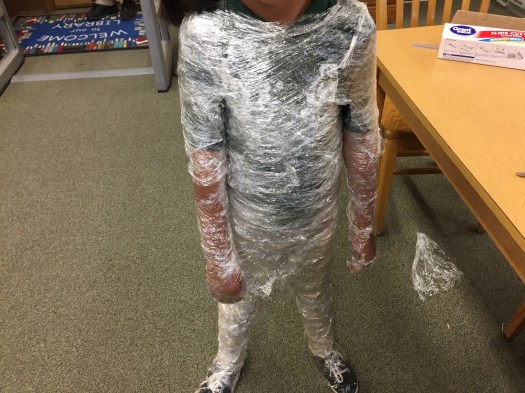
First, wrap your subject in plastic wrap.  Of course, if you are wrapping a person, stop at their neck.  Good heavens.  Do not wrap their head.  They will die.  You will be wrapping the Styrofoam head separately and will attach it to the body later.  I’ll show those head pictures after the body shots.  When you are wrapping with plastic wrap, make sure not to leave any holes, or the tape will stick to the subject.
2017-04-27 13.25.03

One of our brave first-grade volunteers, wrapped in plastic.


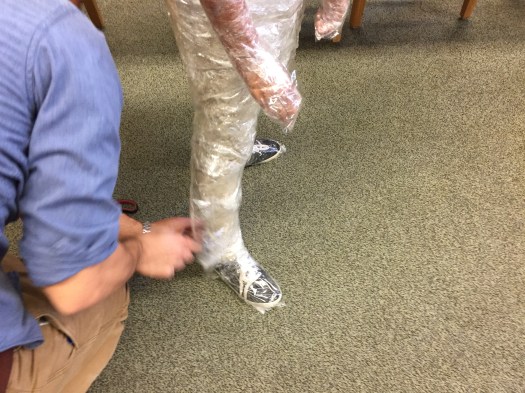
Next, wrap the packing tape all around the subject, covering the plastic wrap. Wrap tightly and cover completely. The more layers, the more solid it will be.
2017-04-27 13.37.57

My friend, Mr. Reming tapes while I take the picture.


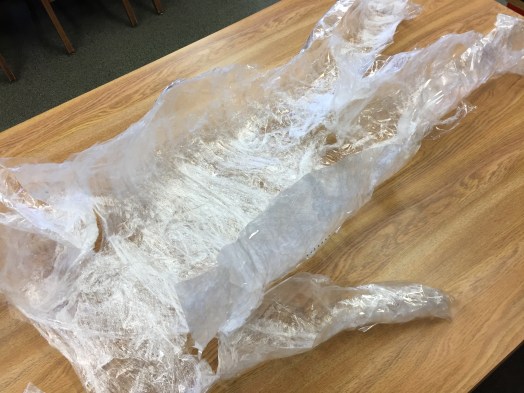
When the person or object is completely covered with a solid layer of tape, make a cut carefully down its back. If your subject is a person, use small scissors and start at the neck. Push your finger ahead of the scissors so you aren’t cutting any clothing or pinching any skin! Cut down to the lower back. Cut along the backs of the arms and legs. Gently extract the person. Same for tape babies: start at the crown of the head with a craft knife or scissors and cut down the back and backs of arms and legs. Extract the doll.
2017-04-27 13.44.12

Like a snake skin. 


Now, gently pull out any excess plastic wrap from inside your sculpture. You may need scissors to cut out some bits.

Finish your sculptures by closing them back up with more tape. Align the seams as closely as possible and tape them shut.  This step is probably the most time-consuming part.

If you are making a baby, you are done at this point!

If you are making a person, you have completed the body. Now, make the head.

I folded up some pieces of bubble wrap and taped them to the temples and top of the head to give the bulbous alien head look.  I also added some to the chin to make it slightly elongated.

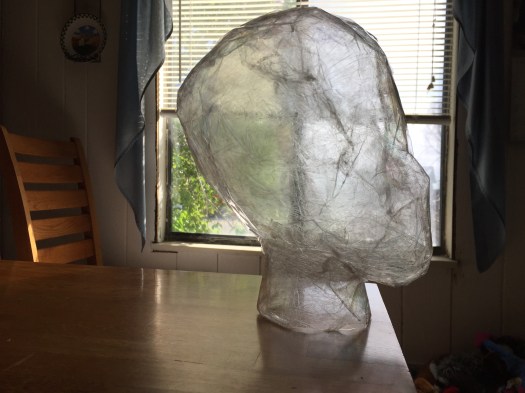
When your head is shaped the way you want it, follow the same process: wrap in plastic wrap.  Cover it in packing tape.  Cut and release the head.  Pull out extra plastic wrap.  Tape up the seam.

Tape your head to the body. You may have to free-form a little bit of upper shoulders with tape. No problem.
2017-04-30 09.18.15

You did it!

2017-05-12 07.14.18

If you want to go full-out alien, reopen the seam in the upper back, giving enough space to put your hand in. Get your LED fairy lights and insert them into the body. Feed the lights down into the arms and legs as far as you can reach. Also place some inside the head: You may need to secure the head lights with a little piece of tape. Leave enough space for the cord to come out of the back, and re-tape the back.

2017-05-15 07.42.49 - Copy

You can modify these sculptures any way you like.  Consider adding flashing eyeballs: Try making a tape sculpture of a plastic Easter egg or small curved object.  Cut it in half and add flashing LED balloon lights (wrapped in a light layer of plastic wrap to disguise the metallic part).  Tape to the faces.

Tape sculptures make highly dramatic and eerie props.  They have an unsettling quality because they are humanoid, yet lack defined facial features.  You will receive many compliments (accompanied by many strange looks).  And, everyone will want to know how to make these.  Now you do!  Have fun!
2017-05-12 07.14.25


Leave a comment

Review: The House Where Evil Lurks

The House Where Evil Lurks: A Paranormal Investigator’s Most Frightening Encounter.  Brandon Callahan.  2014.

In the House Where Evil Lurks, Brandon Callahan and his team investigate the case of a hearing-impaired man who has been attacked in his own home by an unseen force. Callahan beings his narrative by rooting the reader in his uniquely personal vision of what paranormal investigation should be.

Life experiences in the Air Force, struggles with organized religion, and disturbing recurring nightmares all helped drive Callahan to follow a calling as a paranormal investigator. But not just any investigator: Callahan deeply believes in the goal of helping others who are troubled by evil and fear in their homes, unlike other groups that use distressed families to further their own recognition or fame.  Additionally, he is passionate about the broader picture of paranormal investigation.

With his vision firmly in place, Callahan starts his investigative journey. We are introduced to Callahan’s tight-knit team: his brother and his sister-in-law, his good friend who is also a sensitive, and several other trusted teammates.

When Brandon and his team investigate the Missouri home, they discover that it is a hotbed of paranormal activity.  Using EVPs, flashlight communication, and a ghost box the team receives astounding results: contact with multiple entities in the house including one or more that are openly hostile.  Perhaps foolishly, Callahan performs a Ganzfeld sensory-deprivation experiment, thereby opening himself to the spirits.  This turns out to be a choice that has dangerous ramifications when something follows him and his team members home.

In The House Where Evil Lurks, Callahan bares his soul: sharing his own inner conflicts with organized religion and its lack of willingness to help those in need.  His writing is blunt and immediate.  Despite the narrative being rough around the edges and feeling a bit like a cross between memoir-meets-screenplay, it is a fascinating and disturbing read. One appreciates the author’s forthright approach and commitment to his philosophy.


Leave a comment

Review: Nightmare House

Nightmare House.  Douglas Clegg.  2004.

Welcome to a very satisfying ghost story.

It is October of 1926 when twenty-nine-year old Ethan Gravesend takes possession of his new inheritance: a monstrosity of mansion called Harrow located in a quiet village off the Hudson Valley.

Harrow is a legacy from Ethan’s wealthy – and some say, mad – grandfather who collected arcane and ancient objects from around the globe.

Ethan is excited to be back at Harrow.  He has only the fondest memories…so he thinks…of summer and spring visits there as a child.  He meets the old housekeeper, Mrs. Wentworth, and pretty Maggie Barrow who comes in to clean.

The house and its legion of unseen inhabitants soon lets Ethan know it is very much aware of – and anticipating – his presence.  When he and Maggie and her young son Alf make a horrible discovery in a walled-in tower room, Ethan is catapulted into a true nightmare.  There are secrets in the walls.  Secrets in Ethan’s parentage.  And madness potentially within Ethan himself as memories not so fond begin to surface.

Nightmare House has all the delicious elements of a classic ghost story: surprising secrets, an insular, brooding atmosphere, dark imaginative imagery, and classical allusions beautifully woven into the tale.  Clegg’s storytelling is spot-on.  Tantalizing snippets of a gruesome backstory involving an unnatural child and dark spiritualism experiments are revealed by the not-so-innocent Constable Pocket.  Ethan, or Esteban, is narrating from an advanced age, insisting his mind is sharp, but how reliable is he really?  A powerful storm, a possessive presence, a spooky crypt, and two questionable deaths bring a vivid denouement to this nicely-crafted tale.

As a bonus, the edition I read included an extra novella, Purity, which tells the story of another slightly damaged young man.  A sociopath?  With a Lovecraftian god? Also a fascinating read.


2 Comments

Review: Little Heaven

Little Heaven.  Nick Cutter.  2017.

Three guns for hire.  Loners haunted by rough pasts.

Minerva:  No man can kill her, although she wishes one would.

Ebenezer:  The Gardener.  A cultured man of color who screams himself awake every night.

Micah:  One-eyed.  Solid and steadfast.  An enigmatic ex-soldier.

In 1965, they fail to kill each other and end up forming a strange and deadly team. They sign on to help Ellen infiltrate a religious compound and check on her nephew’s welfare.  What they find in Little Heaven is anything but.

Led by a charismatic, disturbed preacher, Little Heaven is slowly descending into hell.  In the remote New Mexico desert, in the shadow of a toxic black monolith, the compound’s land is dying.  Reverend Flesher’s followers are weirdly drained. Their kids are developing a penchant for cruelty.  In the surrounding woods, revolting abominations creep closer and closer.

The unspeakable events that take place in Little Heaven in ’65 set into motion a showdown with an obscene evil fifteen years later.  Flashing forward to 1980: Micah’s daughter is stolen away by the same nightmarish monstrosity that ended up taking the children from Little Heaven.  Payback.

Cutter tells a great story.  Bold, black-and-white illustrations help create an almost a Tarantino-esque, new-old-west vibe to the tale: with modern outlaws driving Oldsmobiles through small, tired desert towns.  But these outlaws are fighting each other, themselves, and a malignant supernatural force. The two story threads years apart pace each other tightly and come to horrific peaks at almost the same time.

Be warned, however: The eeew factor of Little Heaven is high.  Cutter pulls no punches.  The number of things you can’t mentally unsee – and I was heartily wishing I could unsee some of them – is huge.  Every bodily fluid, body part (human and animal), gross insect, and disgusting combination of these that you can think of, Cutter has thought of already and shares in profound and revolting detail.  This is a “wet” book: graphic, grisly and gory.   Cutter bombards all the virtual five senses, not even excepting taste, with over-the-top, cringe-worthy descriptions.

Scrape away the gore, however, and you find the bones of a solid story.  Cutter’s writing is immediate and compelling.  The main characters are unique with nicely fleshed-out backstories.  You come to care about them, these bad-guys-turned-kinda-good.  They have heart.  Tarnished, but true.

On an even deeper level, Little Heaven explores the nature of evil.  Is there a finite amount of evil in the world?  Does evil draw evil to itself?  Is its nature changeable?  Is there such a thing as karmic payback?  Little Heaven raises all of these questions while wading hip-deep through the raw wages of sin and retribution.

A gripping story: not for the squeamish.